The alignment problem
Value isn’t created through ambition. It’s created through alignment between where a business is trying to go and how its operating system is actually built to get there.
That sounds straightforward and in practice, it describes a gap that exists in almost every commercial organisation I’ve worked inside or alongside. The strategy is clear enough. The ambition is real. But the operating system that’s supposed to translate that ambition into predictable, repeatable revenue growth is running on assumptions that were true three years ago, or were never really tested, or were built for a different business than the one that exists today.
Value leaks through that gap, quietly at first, then at a volume that’s hard to ignore.
The architecture
I’ve spent 25 plus years inside enterprise technology businesses, first as a seller, then a sales leader, and eventually building and running global revenue strategy and operations functions. What I’ve learned across those years is less about any particular methodology and more about a pattern. Organisations that consistently create commercial value share a common architecture. Organisations that struggle have usually built that architecture in the wrong order.
The architecture is a sequence: Strategy → Data Foundation → Operating System → Cadence → Scorecard.
That sequence isn’t a framework in the consulting sense as much as an observation of how you have to approach it. Every stage is a prerequisite for the next. You can’t design a useful operating system without a data foundation that reflects your actual strategic choices. You can’t run a cadence that drives decisions without an operating system to inspect. And a scorecard built before the operating system exists is measuring a machine that isn’t there yet; it creates the appearance of rigour without the substance.
The sequence matters because most commercial organisations build it backwards.

The five stages
Strategy here means something specific: a documented, agreed set of choices about where you will compete and how you will win. Not values. Not mission. Choices: which segments, which buyers, which commercial motions, at what price, with what coverage model. If those choices aren’t made and visible, everything downstream optimises for something slightly different. The data models, the territories, the incentive plans, the forecasting methodology; all of it calibrates to whatever assumptions the people building it happen to hold. The result is a highly instrumented engine pointing in slightly the wrong direction. At speed, that’s expensive.
The data foundation is the translation layer. It converts strategic intent into something measurable: account tiering, propensity models, territory design, quota methodology, the pipelines that keep it all current. Most organisations have data. Fewer have a data foundation. The distinction is whether the data is organised around the questions the strategy asks, or just recording what happened. The former gives you something you can manage against. The latter gives you a detailed picture of a past you can no longer change.
The operating system is the least glamorous part of this architecture: the processes, accountabilities, rules, and standards that determine how the commercial organisation actually runs. Pipeline hygiene standards, deal review protocols, escalation paths, territory ownership rules, coverage design. The unsexy middle. It’s also what determines whether the cadence produces decisions or just produces meetings.
Why cadence is the hardest part
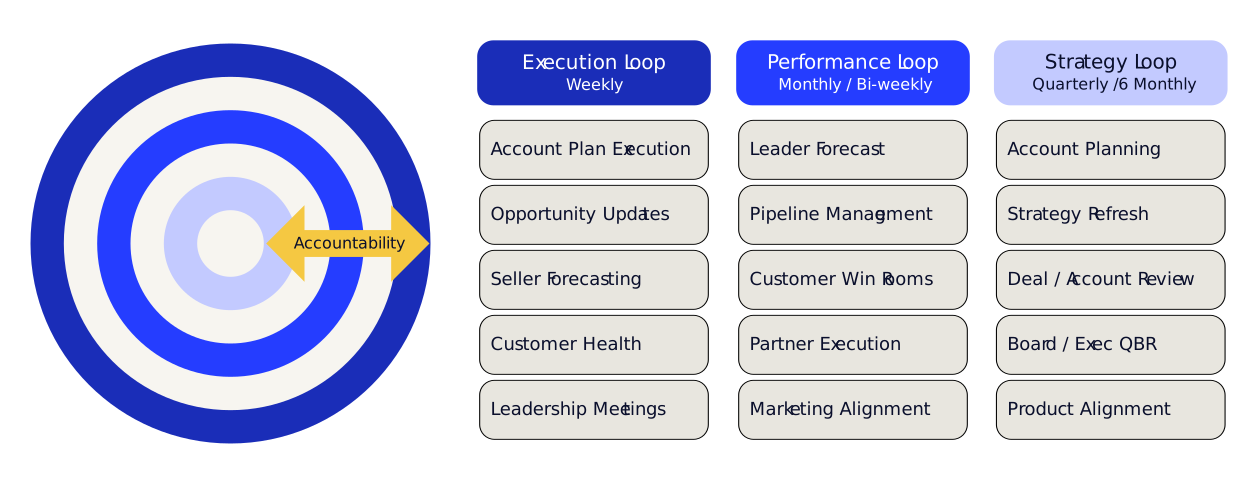
Cadence is where organisations most often fail, and it’s the stage I find sales leaders struggling as we implement it.
Not because the concept is difficult. A structured rhythm of reviews (weekly pipeline calls, monthly business reviews, quarterly planning cycles) isn’t complicated to design. It fails because a well-run cadence exposes things leadership would rather not confront: where the territory design is wrong, where the pipeline is optimistic rather than real, where the incentive plan is producing behaviour nobody intended. A cadence that’s working creates productive discomfort. A cadence that isn’t working becomes a reporting exercise.
The difference is almost never the meeting design. It’s the integrity of the operating system underneath. And the governance above.
RevOps cannot hold accountability in place alone. That’s a structural impossibility that organisations discover the hard way. Governance has to run from the executive team through sales leadership to the field. The operating system has to be owned, not just observed. When it isn’t, the cadence becomes theatre: the right questions get asked, the wrong answers get accepted, and the value that should have been captured that quarter gets deferred to the next one. Those deferrals compound quietly.
I’ve sat in quarterly business reviews where everything looked right, with a structured agenda, solid data, and experienced people in the room, and nothing moved. The operating system underneath was broken. Nobody owned it enough to say so.
What this architecture produces
What I care about most is what this architecture produces at the other end. Not dashboards, not technology, not a more elegant process map.
Operating leverage: the ability of a commercial organisation to grow revenue without proportionally growing cost. Predictability: a forecast that reflects reality rather than internal negotiation, a pipeline that leadership can actually believe. Scalability: a model that holds across regions, across leadership changes, across market shifts, without being rebuilt from first principles every cycle.
The outcomes aren’t incidental, they are deliberately manufactured in the operating system.
In a growth-at-all-costs environment, you can hide a lot of operating inefficiency behind new logo momentum. In a world where profitability matters alongside growth, where businesses are valued on the quality of their revenue as much as the quantity, the operating system is the difference between a business that compounds and one that churns through people, restructuring programmes, and strategy refresh cycles without quite understanding why nothing sticks.
The framework applies regardless of scale. I’ve deployed versions of it in organisations doing a few million in revenue and organisations doing several billion. The customisation changes substantially. The sequence never does. What shifts is the sophistication of the data foundation, the complexity of the operating system, the number of layers the governance has to cover. What doesn’t shift is the dependency structure. Build the scorecard before the operating system and you’ll still be having the same conversations eighteen months later. Just with better-looking charts.
A way of seeing
There’s a version of this that sounds like a methodology to sell people something. I’m not especially interested in that framing because then we need to get specific about your business to add value, and creating value needs the right context to be successful.
What I’m describing is a way of seeing commercial organisations. A set of beliefs about where value lives, why it leaks, and what it takes to unlock it. Those beliefs have been tested across enough contexts, across different industries, different scales, different starting conditions, and different leadership teams, that I trust them, while staying genuinely curious about where they break.
The organisations with the most to gain aren’t always the ones in trouble. Often it’s businesses with strong market positions and real customer value that are underperforming on operating leverage. The commercial engine isn’t aligned with the asset. The gap between what the business could produce and what it does produce is real, and it’s not a strategy problem; it’s a system problem.
That gap is what I find professionally interesting. In most of the organisations I’ve encountered, it’s larger than anyone admits at the start of the conversation. If you’re working through any of these stages, get in touch; understanding how an organisation is put together is one of the things I enjoy diving into.