A design problem, not a process problem
Most commercial transformation programmes start in the wrong place. A new CRO arrives, inherits a structure that accumulated over several leadership cycles, and reaches for the levers that are fastest to pull: territory realignment, a new methodology, a change to the incentive plan. Nine months later the pipeline looks different and the underlying economics don’t.
The reason is that the problem was never a process problem. It was a design problem. And design problems don’t respond to process fixes.
Intelligent GTM design starts earlier and cuts deeper. It’s about the structural choices that determine whether a commercial organisation can actually produce the economics the business needs — not this quarter, but repeatably, at scale, across leadership cycles. Which segments the organisation will compete in. How it will organise to cover them. What roles it will deploy, in what ratio, against which motion. Where it will concentrate investment and where it will deliberately not. Those choices, made explicitly and in the right sequence, are what separate a commercial architecture from a commercial accident.
The first decision: how do you organise?
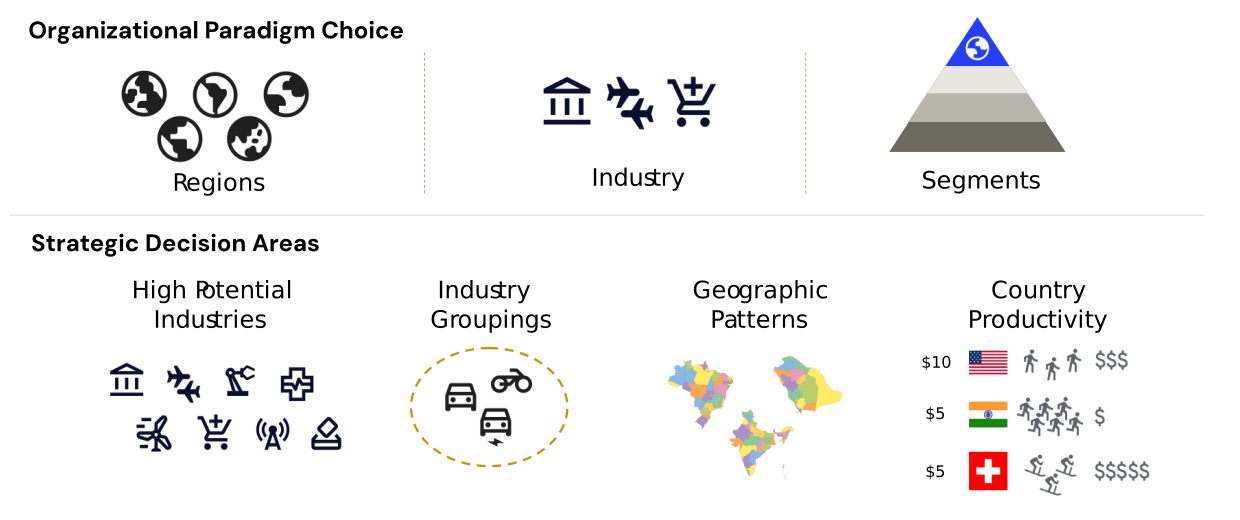
Before territory design, before headcount planning, before quota methodology — there’s a more fundamental question that most organisations skip: what is the primary organising principle of the commercial model?
Three options exist in practice. You organise by geography — regions with P&L accountability, maximum local autonomy, structures that reflect market reality on the ground. You organise by business unit — product or portfolio-aligned go-to-market with specialists who understand the offer deeply, at the cost of customer-facing coherence. Or you organise by segment — enterprise, mid-market, digital, with motions and economics designed to match each tier.
Each is a can be a good choice, however one of them is right in the abstract. The mistake is treating this as a structural preference rather than a strategic decision. The organising principle should follow from where the revenue actually lives, where the growth opportunity is concentrated, and what the commercial motion requires to be executed well. A business with 80% of its revenue in large enterprise accounts and a complex, multi-stakeholder sales cycle has different requirements than one trying to scale a transactional mid-market motion alongside a strategic account base.
Getting this wrong is expensive in a specific way: you build management overhead, specialist overlays, and reporting structures that serve the organisational design rather than the customer. And then you wonder why the cost of sales is climbing while productivity per seller is flat.
Where the money goes, and what it produces
GTM investment is a resource allocation decision. Headcount is the largest cost line in most commercial organisations, and it gets planned with less rigour than almost any other capital decision the business makes. Territories get drawn around existing people rather than around opportunity. Overlays get added to compensate for gaps in the core model rather than as deliberate amplifiers of proven capacity. Specialist roles proliferate because adding them is easier than fixing the underlying coverage design.
The discipline that cuts through this is a simple one: for every role in the commercial structure, the question has to be answerable. What motion does this role support? What is the economic model and at what average deal size, what coverage ratio, what productivity assumption does this role pay for itself? And where is the evidence that those assumptions are real rather than optimistic?
Seller productivity varies enormously across geographies, segments, and motion types. A country with high revenue per seller and high contract value per account has a different capacity model than one with many small accounts and high sales cost relative to the returns. Building a global headcount plan without modelling that variation produces an allocation that’s wrong almost everywhere making it too lean in markets where concentration justifies investment, too heavy in markets where the productivity economics don’t support the coverage model.
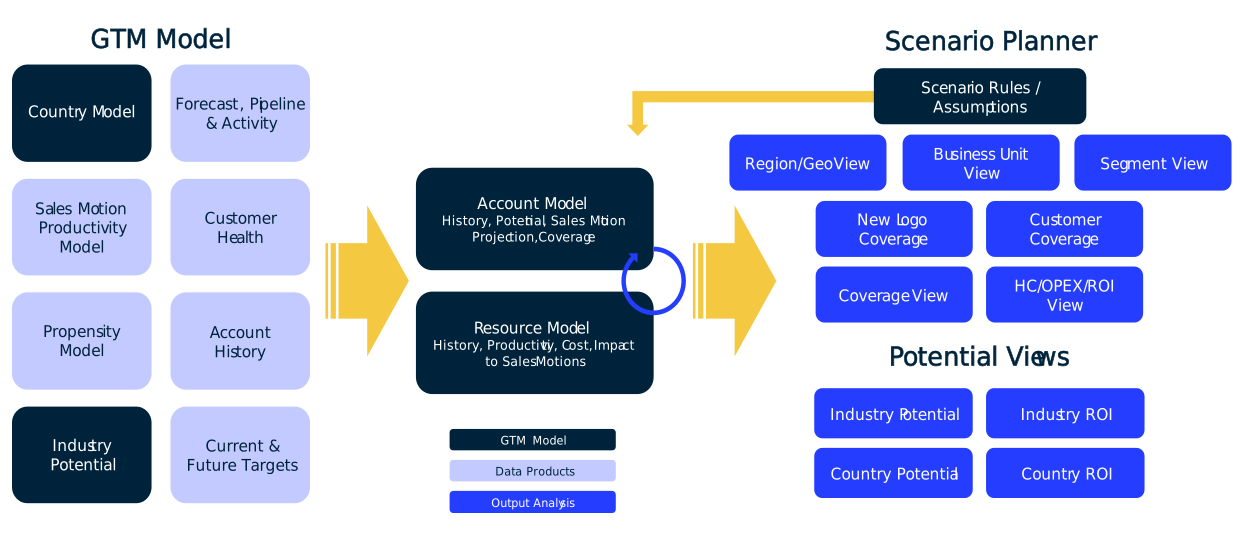
The data architecture that makes this rigorous is a country and account potential model: a bottom-up view of where revenue opportunity actually sits, adjusted for realistic market share assumptions, compared against current coverage and historical productivity. When that model exists, headcount decisions move from negotiation to analysis. When it doesn’t, every planning cycle becomes a negotiation exercise where the markets with the loudest leaders get the resources, not the markets with the best returns.
Roles, clarity, and the cost of ambiguity
Organisational drag in commercial models is almost always structural before it’s motivational. The problem isn’t usually that sellers aren’t trying hard enough. It’s that the model around them is creating friction: duplicated roles, fuzzy ownership at the customer boundary, overlay functions with undefined rules of engagement, handoff points that neither side owns cleanly.
The cost of this is measurable and almost always underestimated. Time spent on internal coordination rather than customer activity. Deal delays at transition points - from pre-sales to commercial, from commercial to delivery, from delivery to renewal. In each case where accountability is unclear, the customer ends up managing the process themselves. Renewal risk that builds silently because no single role has genuine ownership of the customer relationship and the health signal arrives too late to act on.
Fixing this means defining roles around customer outcomes and commercial motions, not around internal convenience. For each role: what motion does it cover, what is it accountable for producing, where does its responsibility start and stop, and what are the KPIs that reflect genuine performance rather than activity? Those definitions have to be consistent globally, built for reuse, and owned rather than aspirational.
Consistency matters here more than most organisations acknowledge. A role that means one thing in North America and something different in EMEA isn’t a role but a regional label. You can’t compare performance, can’t build management capability at scale, can’t identify what good looks like and replicate it. Global standards on role design aren’t bureaucracy. They’re the prerequisite for intelligent resource allocation.
Global consistency as the platform for regional intelligence
The tension in large enterprise commercial organisations is always the same: global standards feel like they don’t account for local reality, and local autonomy feels like it makes global comparisons impossible. Both instincts are partially right.
The answer isn’t a compromise, it should be a sequence. The centre defines the architecture including the organising principle, the role standards, the data model, the performance framework, the coverage logic. That consistency is non-negotiable, because without it you can’t identify which regional performance differences are real and which are artefacts of different definitions. When one market is outperforming another, you need to know whether that reflects genuine commercial capability, a better account set, a different coverage model, or simply a different way of counting.
Within that architecture, regional adaptation is entirely legitimate and often necessary. Which industries to prioritise, where to concentrate specialist resource, how to sequence new-logo versus expansion investment, how to weight partner-led versus direct coverage. Those decisions should be made locally, with global data behind them, and with the accountability for the outcomes sitting clearly in the region.
The architecture makes that accountability real. When every market is modelled on the same potential methodology, planned against the same productivity assumptions, and measured against the same commercial framework, the conversation between the centre and the field changes fundamentally. It moves from narrative to evidence and the outliers in both directions become visible in a way that creates genuine learning rather than politics.
The rebuild logic
When a commercial organisation needs to be restructured rather than optimised, the sequence matters as much as the content.
The starting point is always the strategy: which segments, which motions, which economic model. Not what the business has been doing, but what it’s trying to build. Restructuring without that clarity produces a new org chart that runs the old model with different names on it.
From strategy, the data work defines what the opportunity actually looks like: where potential is concentrated, which geographies and verticals have the economics to justify investment, what the realistic productivity assumptions are by motion and segment. That analysis drives coverage design guiding how many sellers, in what roles, against which account sets, with what overlay support. It also informs smart targeting: once you know where the real opportunity lives, you can build the signal layer that tells the field where to focus within it.
Role design follows coverage design, not the reverse. The roles that exist should be the ones the coverage model requires, built around the motions the strategy demands. Roles that exist for historical reasons, or as compensation for structural problems the model created, get eliminated or consolidated.
The incentive design comes last. It should reinforce the motion the structure was built to run, not try to correct a coverage model or role design that doesn’t work without financial engineering.
That sequence of strategy, potential, coverage, roles, incentives, is where intelligent GTM design produces its commercial return. Not in the sophistication of the analytics, not in the elegance of the operating cadence, but in whether the structure that results actually fits the economic opportunity the business is trying to capture. Most of the value in large enterprise commercial organisations is sitting in that gap between the structure that exists and the structure the opportunity requires.
AI will amplify whatever commercial structure a business has already built. The organisations that compound from that are the ones who designed their structure around real opportunity before they deployed it. The rest will just move faster in the wrong direction.